Search This Blog
Beer While Running?
Sponsored Athlete of the Month


Things the Doctor Learned while Running her First Ultra-


- Sunvisors are a great way to create a lava flow of damage on your scalp. Hence the dorky hats that they all wear...I'm now sold.
- Longsleeves are optimal for decreased water loss (High meadow GoLite long sleeve is "barely there")
- Salt pills are a must. If you cramp, you need salt pills (HammerGel Enduralytes are my favorites).
- In the mountains,bring armwarmers that you can chuck.
- Wear a fuelbelt (Nathan is my favorite)

Achilles Injuries and Calf Contracture


Often a patient wants to strengthen it thinking that pain equals weakness. However, this is absolutely the opposite of what truly needs to happen.Barefoot Running in Boulder...Biomechanical Pros and Cons
Hand Numbness, Carpal Tunnel, and Other Fixable Symptoms...
I recently ran into a party who had hand numbness that he had decided was permanent, though he had never seen a doctor. We began a conversation about carpal tunnel syndrome, disc degeneration and everything in between related to hand pain and “incurable ailments.” The human body is a mix of things we can overuse and things that just plain wear out after all of our fun. Sometimes it is genetic, sometimes the effect of an accident, or a catastrophe, but usually it is common and simple to fix.
Hand and arm numbness are usually caused by the compression of the nerve along its course from exiting the spinal cord (at the bottom of your neck) to its end destination in the hand. Compressed anywhere along its track, the patient can get the same symptoms of numbness, weakness, tingling, or just overall discomfort. The three most common points in a healthy population (ie Boulder) are at the Brachial Plexus in the neck, under the Pectoralis Musculature, or at a point just below the elbow where the Pronator Teres crosses the nerve bundle. Bony impingment or compression by disc are also less likely causes that need to be mentioned.
The worst scenario and a patient example:
Rarely, the numbness can be causes by bony degeneration within the neck. This usually occurs above the age of forty if it is going to happen. The degeneration which places irritation on the nerve by new bony outgrowths (osteophytes) or by the effects of disc degeneration in which the disc itself pushes back into the spinal canal and pushes on the spinal cord. Again, this is seen in the older population in which the wear and tear on the vertebrae are more than it is made for and the disc degenerates under the stress of poor posture and increased abnormal pressures over a long period or just plain old trauma.
Sometimes the bony degeneration can cause a tendency to protect by the neck musculature, and the tightening of the musculature puts pressure on the nerve as it exits between the vertebrae. I saw this exact case in an old race car driver who had hit numerous walls at over 140mph. His x rays showed no disc left, the neck was almost one complete bone (instead of seven!) and his oblique xrays (which show the little nerve roots) showed absolutely no room for the nerves to exit the spine due to all the osteophytic outgrowths and the reduction in the disc height. This patient however did improve and had a complete removal of symptoms as the causes of his pain was not the bony changes but the tight musculature caused by the bony changes. (We did traction, MRT, Activator Adjusting, and some lifestyle changes.) Amazing. He is now retired and traveling and can now completely feel his right hand, which he had issues with for 5+ years!
This was an unusual case, as I primarily treat mid-30’s patients who have these symptoms from repetitive stress injuries from typing, mousing, or their sport of choice. I put the above information in to show that quite a few symptoms can be caused by bone or disc involvement and it is VERY important to seek medical advice/care to make sure that you get back on track quickly. A nerve that begins to die (the tingling is a reaction of degeneration, or nerve death as it dies without feedback from the spinal cord). Most patients I have are not this complicated and are simply a muscular compression based patient.
Commonality:
Most of my patients whom I have helped had compression in the chest region from overly tight Pectoralis musculature compressing the Brachial plexus OR at a region just below the elbow from to give sensation and muscular control to your hand. Muscular causes can create nerve irritation by mechanical compression as well as chemical irritants caused by plain old inflammation (this is why its important to ice and treat this before it gets out of hand! No pun intended!). Compression at the Pectoralis Musculature can be caused by improper posture, which can be something that a patient has trouble changing on their own. When the body is stooped over a computer all day or slumped into a sofa, the musculature on the midback/scapular region is stretched from the bodies weight supported by “hanging” on the rhomboids and the other
musculature of the midback. While the stretching phenomena is occurring in the back of the body, the pectoralis muscle is allowed to stay in a shortened/contracted state for long periods of time and its length shortens permanently (or until it is fixed). An abnormally tight pectoralis muscle puts pressure on the structures under the muscle, which contain a space that carries the brachial plexus. Irritation on this plexus is enough to give tingling or numbness to the hand which is felt first, before the hand begins to lose its strength. I have had several patients with this issue. One was a football player who spent too much time at the benchpress and the second was a patient who was addicted to sitting sloppily at his computer and additionally his workstation did not fit him even remotely, reinforcing the slouched and hunched over posture that he finally attained.
The most common cause of hand numbness (usually the pinky and the ring finger) that I have found have been caused by tight pronator teres musculature. This muscle crosses over the major nerve bundle that innervates your forearm and hand. Crossing the soft tissue at the elbow, this muscle can compress the ulnar and median nerve.
What can tighten this muscle? A bitty list of repetitive stress injuries (RSI's)
- Reaching out of your space to do computer or office work
- Rolling around that mouse for a prolonged period (get a laser/thumb mouse)
- Over-use of the chuckstick at the dog park (have someone else try it)
- Running with arms at a less-than-90 degree angle ( 90 degrees is best)
- Carrying numerous jugs of milk in one hand (Starbucks people beware one is good)
- Working under a car with the arms at an unusual position (Do it if you must)
- Painting or home handywork (Why people get frozen shoulder and neck pain)
= Pretty much anything repetitive that lasts over an hour a day is a pure red flag!
What can be done? If its bony- its complicated. Usually traction in the neck (done by a friend, a machine/tool, or your doctor can cause the musculature to relax and the disc to "plump" back up by the principle of imbibition. After the age of twenty the blood supply to the disc ceases and the only form of nutrient/blood flow to the disc is through joint motion. This is why stretching, yoga, and regular adjustments are good for the spine. A vertebral segment that does not move for an extended period (past a month or two) degenerates. The scar tissue that holds the muscle in a shortened position can be removed by Myofacial Release Technique (MRT, similiar to ART) to decrease muscular adhesions and to retrain the muscle to function at each range of motion. Proprioceptive training exercises can be done to train the muscle when and when not to contract and proprioceptive taping (I use kinesiotaping) can be done to decrease the tension within the muscle, allowing the muscle to stay relaxed and to remind the user to not overuse the muscle. Adjusting of the elbow and wrist also allow the joints to move in their full range of motion as well as reset the muscular length through a nerve-feedback system.
Goodluck in your search for information, if you have any questions or would like more information, please feel free to contact me! Happy Trails,
Doc Lisa
Notice: Nothing given in this posting is meant to be taken as medical advice but to be used for educational purposes only. If you are suffering from any symptoms as described above you should seek medical advice as your condition may not be related to this posting. We are not held accountable for any mis-treatment by the readers of the posting and re-iterate that this posting is only meant to be educational for the purposes of knowing when to seek care and why.
Running Gaits and Leg Pain (ITB in specific)
- Over striding (90% of runners)-The foot should land just below your sternum with 2/3 of your stride behind you.The vertical shear force behind the patella is increased
- Heel striking-Increased forces vibrating up the landing heel, A "breaking" effect. Instead land midfoot, aiming for slightly behind the ball of your foot.
- Flat Arches (pronated feet) Over-stretch phenomena of the ligaments and fascia of the bottom of the foot. Often caused by standing in archless footwear. The muscles of the foot tire and the weight of the body stretches the fascia/ligaments. (Via the element of plasticity) often to the point of pain/scarring: plantar fascitis!
- Weak Hip Musculature (external rotators/abductors)- The muscles that hold the hips steady as you run can fatigue or simply not fire. The hip "sags" vertically, causing the knee to move medially (toward centerline). A twisting motion is placed into the knee: knee pain/swelling. The ITB is over stretched as the knee moves medially. Increases the stress on the ITB leading to tissue overloading aligned failure
- Trail Running Technique/Gait Modifications for Rocky Terrain: Most trail runners modify their gait for difficult terrain. The most common modification: a scissor gait. (The foot prints land on the same line which is in the center of the patients' body. This runner usually with their knees close together as well (also stresses the ITB)
Changing these stressors on the knee/ITB region will reduce the amount of biomechanical overuse on the region.
How to solve this problem?
- Have your gait videotaped from the side, the back, and the front so you can see if you are doing any of the above (I do so at my clinic, you can use a good camera and upload it onto your computer. If you are having trouble visualizing it, you can put it into paintbrush and draw the lines in).
- Check your orthodics (which may be old and not work anymore...) to make sure you have a level landing bed so your foot lands with a perfect arch, reducing the medial pull on the knee which comes from a collapsing arch.
- Strengthen the muscles creating a natural arch (Posterior Tib.)
- Do drills training your knee to stay over your second toe (not letting it fall inward or reside over the fifth toe) and while you are at it, do drills to fix your gait mistakes found in the video... a whole different topic!
- Strengthen your Glute Medius and Minimus by doing hip raises, which should be done after your run.. some runners don't see it on videotape until the muscles are fatigued (like the midway point in your marathon/15k).
- Practice running with your stance wide enough that your foot placement does not overlap on trail runs/rocky terrain runs.
Good Luck Guys- hope this helped! As usual, I am happy to give gait ideas to the needy =) Recommended text: Jack Cady (PT), Efficient Running (http://www.stridemechanics.com/) , Chi Running, Danny Dreyer (http://www.amazon.com/ used books)
Happy Trails! -Doc Lisa
Knee Care 101: It all adds up.. but then what?
- Keep the biomechanics as close to neutral (a whole other group of education sessions.. )
- Watching for overuse or overstrain to an unprepared region (such as increasing speed/climbing/adding miles on too early or in too large of chunks)
- Preventative Maintenance (Our goal for this conversation!!)
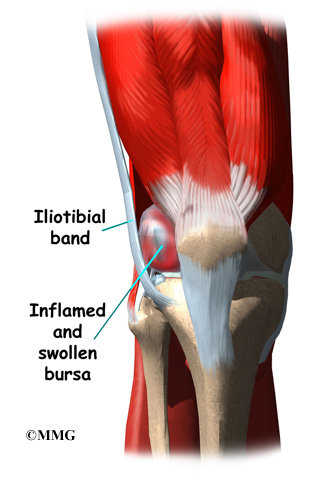
- Example: On a cyclists ITB (Iliotibial band, or the thick fibrous sheath on the outer thigh, this band grows thicker and can cause great pain as it shrinks or stretches.
- Example: On a runner, they can get plantar fascitis as the abnormal overuse from improper gait and usage leads to shortened fascia on the bottom of the foot
- Example: As people walk around with bad posture (slouching with rounded shoulders) their Pecs become shortened and as they age they cannot stand up properly because the ligament on the front of their spine, very similar to fascia, shrinks and will no longer stretch back to neutral!
The Glycogen Window and Cheap Gatorade..
Footcare and black toenails...